Code
import pandas as pd
import ocha_stratus as stratus

from src.datasources import imerg, ibtracs, zma, codab
from src.constants import *Below is the end-to-end workflow for extracting and analyzing daily soil moisture over Cuba at storm landfall dates:
import pandas as pd
import ocha_stratus as stratus
from src.datasources import imerg, ibtracs, zma, codab
from src.constants import *import ee
import geemap
ee.Authenticate(auth_mode="gcloud")
ee.Initialize()adm0 = codab.load_codab_from_blob()
adm0 = adm0[["ADM0_ES", "ADM0_PCODE", "geometry"]]blob_name = f"{PROJECT_PREFIX}/processed/ibtracs/zma_tracks_2000-2024.parquet"
df_ibtracs = stratus.load_parquet_from_blob(blob_name)df_ibtracs_agg = (
df_ibtracs[df_ibtracs["landfall"]]
.groupby("sid")
.agg(
valid_time_min=("valid_time", "min"),
valid_time_max=("valid_time", "max"),
wind_speed_max=("wind_speed", "max"),
)
.reset_index()
)# was having issues w/ this so i just got the FC from FAO which
# is already on earth engine
# geemap.geojson_to_ee(geojson)
# geojson = adm0.to_json()
# ee_feature_collection = geemap.geojson_to_ee(geojson)
fc_adm0 = ee.FeatureCollection('FAO/GAUL/2015/level0').filter(ee.Filter.eq('ADM0_NAME', 'Cuba'))
# Load ERA5 Daily Soil Moisture dataset
ic = ee.ImageCollection("ECMWF/ERA5_LAND/DAILY_AGGR")
bands = [
"volumetric_soil_water_layer_1",
"volumetric_soil_water_layer_2",
"volumetric_soil_water_layer_3",
"volumetric_soil_water_layer_4"
]
ic_sub_bands = ic.select(bands)
# Function to compute mean across the four soil moisture bands for each image
def mean_soil_moisture(img):
mean_img = img.select(bands).reduce(ee.Reducer.mean()).rename("soil_moisture_mean")
return mean_img.copyProperties(img, img.propertyNames())
# Map the function over the collection to retain an ImageCollection of mean images
ic_mean_sm = ic_sub_bands.map(mean_soil_moisture).filterBounds(fc_adm0)
# Print info for the first image to verify
first_img = ic_mean_sm.first()
print(first_img.getInfo())Filter collection to storm dates
# Add a 'valid_date_min' property (YYYY-MM-DD) to each image in the collection
def add_valid_date_min(img):
    date_str = ee.Date(img.get("system:time_start")).format("yyyy-MM-dd")
    return img.set("valid_date_min", date_str)


# Map to add the property
temp_ic = ic_mean_sm.map(add_valid_date_min)

# Now filter using the new property and the list of storm dates
storm_dates = df_ibtracs_agg["valid_time_min"].dt.strftime("%Y-%m-%d").tolist()
storm_dates_ee = ee.List(storm_dates)
ic_sm_storm_date = temp_ic.filter(
    ee.Filter.inList("valid_date_min", storm_dates_ee)
)
print("Filtered collection size:", ic_sm_storm_date.size().getInfo())
ic_sm_storm_datedf_mean = geemap.zonal_stats(
ic_sm_storm_date, fc_adm0, stat_type="MEAN", scale=10000
)# i thought the above would save in memory as data.frame, but i guess not.
# will look more into gee.zonal_stats() at a later point
df_mean = pd.read_csv("zonal_stats.csv")# Pivot all columns ending with '_soil_moisture_mean' to long format and parse dates
value_vars = [
col for col in df_mean.columns if col.endswith("_soil_moisture_mean")
]
# Keep only columns in value_vars plus ADM0_NAME before melting
cols_to_keep = value_vars + [
col for col in df_mean.columns if col == "ADM0_NAME"
]
df_mean_sub = df_mean[cols_to_keep]
# Use melt to reshape to long format
if value_vars:
df_long = pd.melt(
df_mean_sub,
id_vars=[col for col in df_mean_sub.columns if col not in value_vars],
value_vars=value_vars,
var_name="parameter",
value_name="value",
)
# Extract date from 'parameter' column (e.g., '20011104_soil_moisture_mean')
df_long["date"] = pd.to_datetime(
df_long["parameter"].str.extract(r"(\d{8})")[0],
format="%Y%m%d",
errors="coerce",
)
else:
df_long = df_mean_sub.copy()
df_long = df_long[
["date", "parameter", "value"]
+ [
col
for col in df_long.columns
if col not in ["date", "parameter", "value"]
]
]
df_long["parameter"] = "Soil Moisture Mean"
df_long.head() # Show preview of the resultload storms
df_storms = ibtracs.load_storms()
# Filter df_storms to only sids present in df_ibtracs_agg
df_storms_cuba= df_storms[df_storms["sid"].isin(df_ibtracs_agg["sid"])]
# Join the "name" column from df_storms to df_ibtracs_agg by "name"
df_ibtracs_agg_labelled = df_ibtracs_agg.merge(
    df_storms[["sid", "name"]], on="sid", how="left"
)


# df_long = df_long.merge(
#     df_storms_cuba[["sid", "name"]], left_on="parameter", right_on="sid", how="left"
# )

# Create a 'date' column in df_ibtracs_agg_labelled by converting 'valid_time_min' to date
df_ibtracs_agg_labelled["date"] = pd.to_datetime(df_ibtracs_agg_labelled["valid_time_min"]).dt.date

# Also ensure df_long["date"] is of type date (not datetime)
df_long["date"] = pd.to_datetime(df_long["date"]).dt.date

# Merge 'name' from df_ibtracs_agg_labelled into df_long by 'date'
df_long_labelled = df_long.merge(
    df_ibtracs_agg_labelled[["date", "name"]],
    on="date",
    how="left"
)df_storms.head()| storm_id | sid | atcf_id | season | number | name | provisional | created_at | |
|---|---|---|---|---|---|---|---|---|
| 0 | 0eae9884-5a95-427e-813f-24b6948adfc8 | 1842298N11080 | None | 1842 | 1 | UNNAMED | False | 2025-05-13 23:12:11.828324 |
| 1 | 654c51b2-e783-4ebc-9089-d760f2550a19 | 1845336N10074 | None | 1845 | 1 | UNNAMED | False | 2025-05-13 23:12:11.828324 |
| 2 | 78e5587a-6792-4336-81f3-ab3a2fda026c | 1848011S09079 | None | 1848 | 1 | UNNAMED | False | 2025-05-13 23:12:11.828324 |
| 3 | fb2cdc51-02c3-42a2-a22a-5a9dd37da2c7 | 1848011S09080 | None | 1848 | 2 | UNNAMED | False | 2025-05-13 23:12:11.828324 |
| 4 | 3a0add51-96ee-4a7f-934d-bf0f599673ed | 1848011S15057 | None | 1848 | 3 | UNNAMED | False | 2025-05-13 23:12:11.828324 |
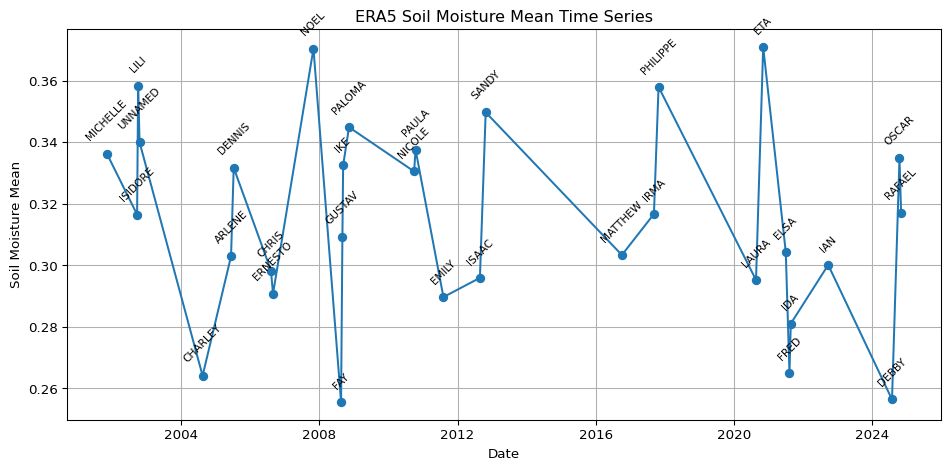
import matplotlib.pyplot as plt

plt.figure(figsize=(10, 5))
plt.plot(
    df_long_labelled["date"],
    df_long_labelled["value"],
    marker="o",
    linestyle="-",
)
plt.xlabel("Date")
plt.ylabel("Soil Moisture Mean")
plt.title("ERA5 Soil Moisture Mean Time Series")
plt.grid(True)
plt.tight_layout()
for i, row in df_long_labelled.iterrows():
    if pd.notnull(row["name"]):
        plt.annotate(
            row["name"],
            (row["date"], row["value"]),
            textcoords="offset points",
            xytext=(0, 10),
            ha="center",
            fontsize=8,
            rotation=45,
        )
plt.show()